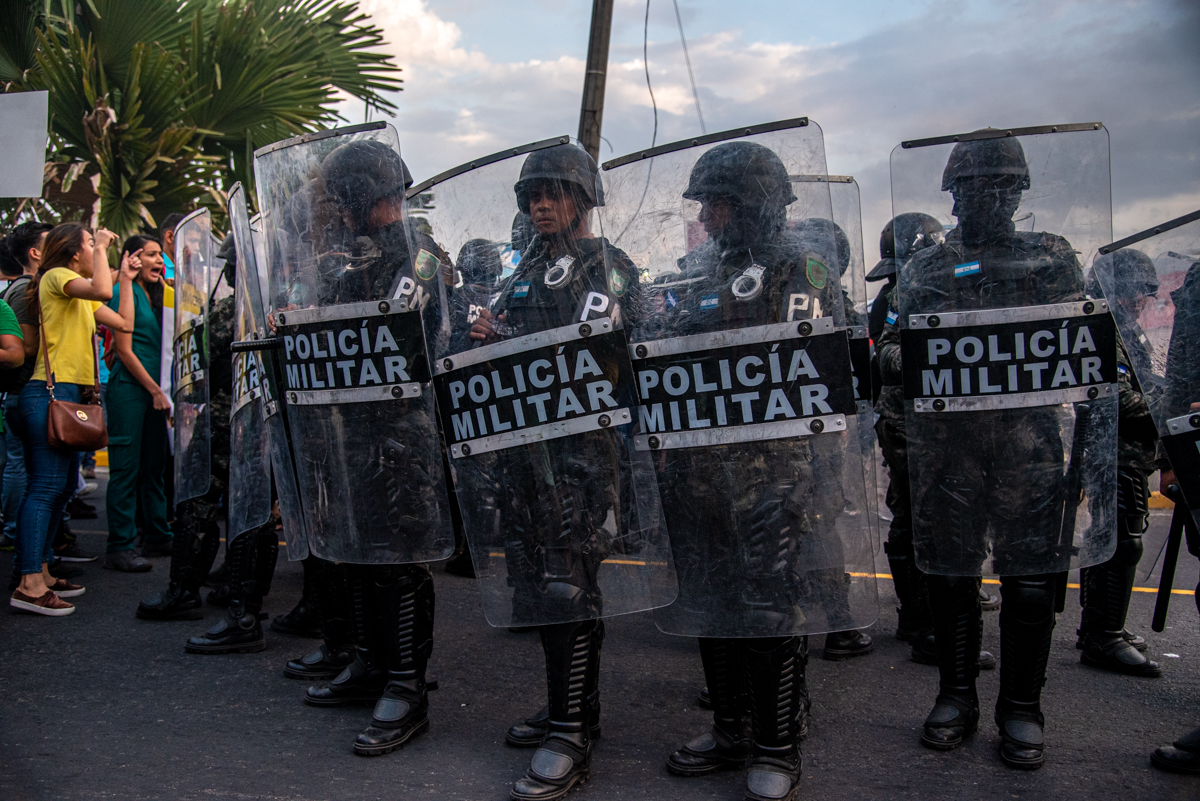
How surveillance tech helped protect power — and the drug trade — in Honduras
I. Hery Flores kept calm when officers approached him as he departed a Tegucigalpa gas station in the early summer of 2021. Only one was in a blue police uniform. The others wore jeans and button down shirts — typical attire for police investigators in Honduras’ capital city. But then they slapped on handcuffs without giving him time to react. Later he realized they never showed him an arrest warrant.
They shoved Flores into a car without license plates and drove him around on Tegucigalpa’s winding roads. The officers interrogated him for more than two hours about his political activity as a student at the National Autonomous University of Honduras and as a member of a political party called Libre. Other Hondurans who had been murdered or disappeared in recent years — Berta Cáceres, Sneider Centeno, Vicky Hernández — flashed through Flores’ mind. “Their primary objective wasn’t to arrest me,” he later told me.
He persuaded one of them to let him call his mother. “The police have detained me and I’m at the Kennedy police station,” he told her. Within the hour, people were calling for his release on social media. One was the Libre party presidential candidate Xiomara Castro. Another was her husband, Manuel “Mel” Zelaya, the former Honduran president who was deposed through a coup d’etat in June 2009 and later became head of the Libre party.
Before the day was through, Flores had been charged with “aggravated arson.” Authorities alleged he set a pharmacy on fire during a 2019 protest, which he denies. Flores spent a week and a half in pre-trial detention in a maximum-security prison until a judge decided he was not a flight risk and granted his provisional release while his trial was ongoing.
How surveillance tech helped protect power — and the drug trade — in Honduras
I. Hery Flores kept calm when officers approached him as he departed a Tegucigalpa gas station in the early summer of 2021. Only one was in a blue police uniform. The others wore jeans and button down shirts — typical attire for police investigators in Honduras’ capital city. But then they slapped on handcuffs without giving him time to react. Later he realized they never showed him an arrest warrant.
They shoved Flores into a car without license plates and drove him around on Tegucigalpa’s winding roads. The officers interrogated him for more than two hours about his political activity as a student at the National Autonomous University of Honduras and as a member of a political party called Libre. Other Hondurans who had been murdered or disappeared in recent years — Berta Cáceres, Sneider Centeno, Vicky Hernández — flashed through Flores’ mind. “Their primary objective wasn’t to arrest me,” he later told me.
He persuaded one of them to let him call his mother. “The police have detained me and I’m at the Kennedy police station,” he told her. Within the hour, people were calling for his release on social media. One was the Libre party presidential candidate Xiomara Castro. Another was her husband, Manuel “Mel” Zelaya, the former Honduran president who was deposed through a coup d’etat in June 2009 and later became head of the Libre party.
Before the day was through, Flores had been charged with “aggravated arson.” Authorities alleged he set a pharmacy on fire during a 2019 protest, which he denies. Flores spent a week and a half in pre-trial detention in a maximum-security prison until a judge decided he was not a flight risk and granted his provisional release while his trial was ongoing.