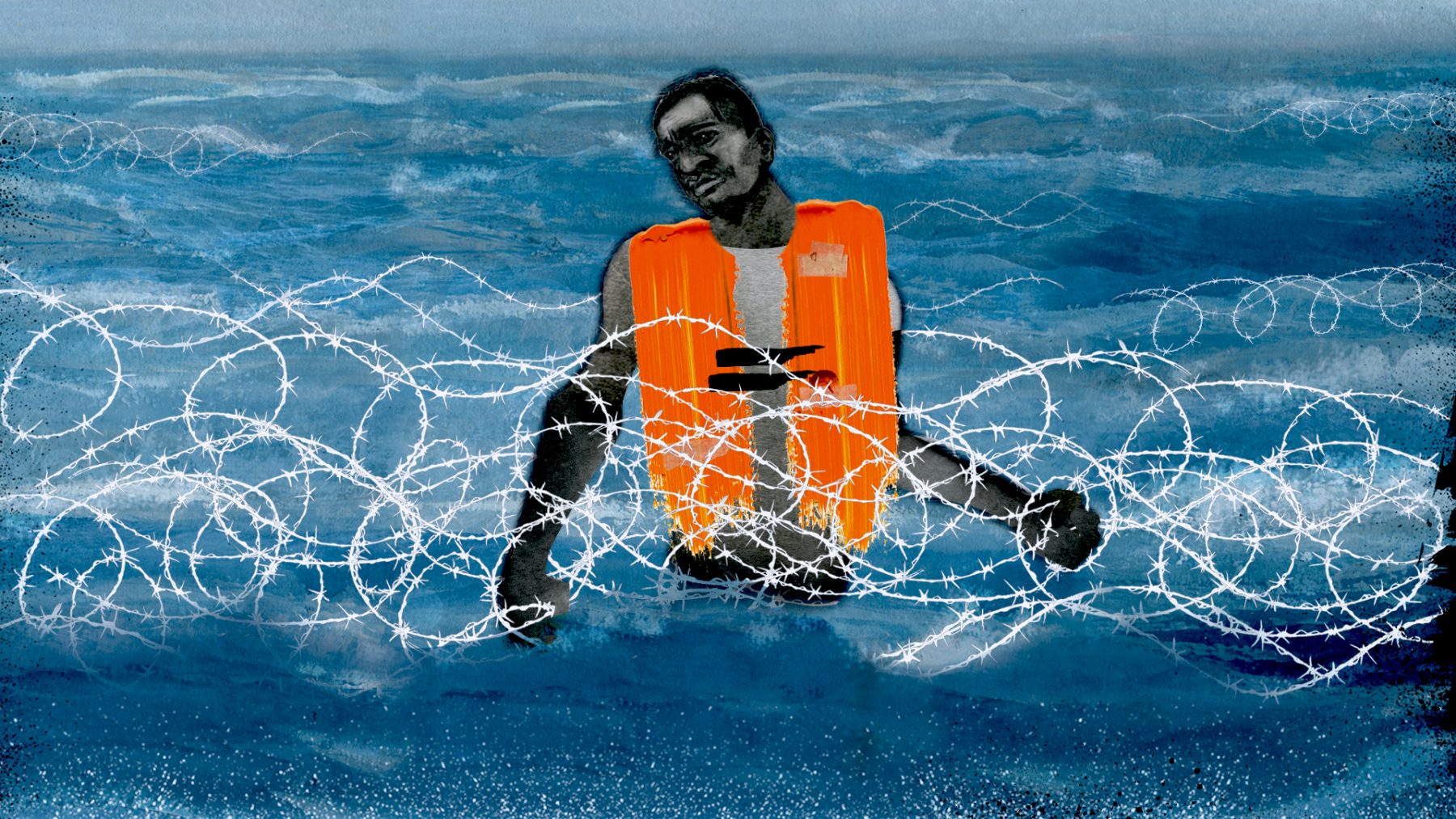
How an EU-funded agency is working to keep migrants from reaching Europe
When he saw the Tunisian coast guard coming, Fabrice Ngo knew he wouldn’t make it to Italy that day. The young Cameroonian had pushed off from the shore of the Tunisian city of Sfax in a small metal boat with 40 others. They left under the cover of night alongside seven other boats. The small fleet motored north toward Italy, spread out, but all with the same destination. In the distance, the lights of seaside towns dotted the coastline.
The Tunisian coast guard found them two hours into their journey. As the police vessel approached, fear gave way to disbelief. The coast guards — in uniform and on an official ship — boarded the metal dinghy, dislodged and seized the boat’s motor and then sped off, motor in hand. The group of 40, most of them from West Africa, were left at sea with no motor. Panic ensued. Some began paddling with their bare hands.
The Big Idea: Shifting Borders
Borders are liminal, notional spaces made more unstable by unparalleled migration, geopolitical ambition and the use of technology to transcend and, conversely, reinforce borders. Perhaps the most urgent contemporary question is how we now imagine and conceptualize boundaries. And, as a result, how we think about community.
In this special issue are stories of postcolonial maps, of dissidents tracked in places of refuge, of migrants whose bodies become the borderline, and of frontier management outsourced by rich countries to much poorer ones.
“We didn’t know what to do. We couldn’t move forward. We started tearing up the fuel cans to paddle, everyone had their hands in the water,” Ngo told us. “Some brave ones undressed and jumped in the water to push the boat along.” (We have changed Ngo’s name to protect his safety.)
By mid-afternoon the following day, the boat had floated toward a small chain of islands off the coast of Sfax. Again, the Tunisian coast guard reappeared, towed the group farther out to sea and, again, left them floating at sea, still with no motor.
How an EU-funded agency is working to keep migrants from reaching Europe
When he saw the Tunisian coast guard coming, Fabrice Ngo knew he wouldn’t make it to Italy that day. The young Cameroonian had pushed off from the shore of the Tunisian city of Sfax in a small metal boat with 40 others. They left under the cover of night alongside seven other boats. The small fleet motored north toward Italy, spread out, but all with the same destination. In the distance, the lights of seaside towns dotted the coastline.
The Tunisian coast guard found them two hours into their journey. As the police vessel approached, fear gave way to disbelief. The coast guards — in uniform and on an official ship — boarded the metal dinghy, dislodged and seized the boat’s motor and then sped off, motor in hand. The group of 40, most of them from West Africa, were left at sea with no motor. Panic ensued. Some began paddling with their bare hands.
The Big Idea: Shifting Borders
Borders are liminal, notional spaces made more unstable by unparalleled migration, geopolitical ambition and the use of technology to transcend and, conversely, reinforce borders. Perhaps the most urgent contemporary question is how we now imagine and conceptualize boundaries. And, as a result, how we think about community.
In this special issue are stories of postcolonial maps, of dissidents tracked in places of refuge, of migrants whose bodies become the borderline, and of frontier management outsourced by rich countries to much poorer ones.
“We didn’t know what to do. We couldn’t move forward. We started tearing up the fuel cans to paddle, everyone had their hands in the water,” Ngo told us. “Some brave ones undressed and jumped in the water to push the boat along.” (We have changed Ngo’s name to protect his safety.)
By mid-afternoon the following day, the boat had floated toward a small chain of islands off the coast of Sfax. Again, the Tunisian coast guard reappeared, towed the group farther out to sea and, again, left them floating at sea, still with no motor.