Medieval history powers a crisis of identity in Lithuania and Belarus
For Lithuanians, their country’s medieval history has been a source of pride, pageantry and identity. The Grand Duchy of Lithuania was a cosmopolitan, multi-ethnic, multilingual state that sprawled across swathes of the Baltics and eastern Europe, including modern-day Lithuania, Belarus, and parts of Poland, Latvia, Ukraine, Moldova, and Russia.
The Big Idea: Battling history
Governments rewrite history to further their political goals. School boards insist on rewritten history textbooks to elevate elite groups or privilege favored narratives. But unsavory motives are only one aspect of the rewriting history project. Other impulses are noble, idealistic, and sincere.
All are significant and will impact our politics, international relations, social understandings, economic arrangements. This project will look at specific battles over history — but it’s never really about history.
It’s always a fight over the present.
Its heyday, historians agree, was in the late 14th century and through much of the 15th century before the Union of Lublin in 1569 formalized a Polish-Lithuanian Commonwealth.
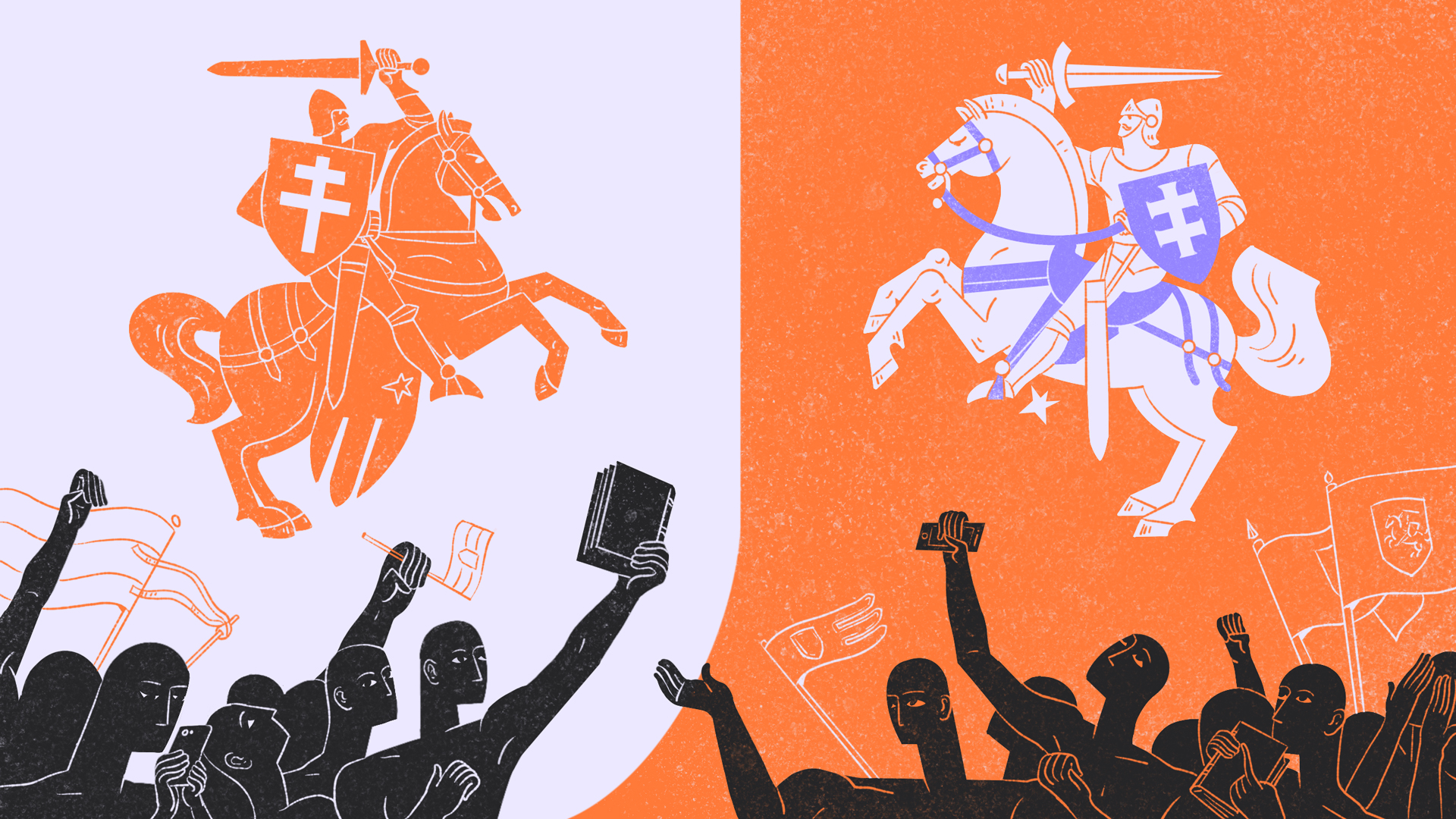
Small as Lithuania is, compared to the Grand Duchy of Lithuania, it considers itself, and has broadly been considered to be the keeper of the Grand Duchy’s historical legacy. Lithuania’s coat of arms and its euro coins feature its iconic knight mounted, sword aloft, on a charging warhorse.
The Lithuanian journalist Vaidas Saldžiūnas remembers going into a souvenir shop on a trip to neighboring Belarus and seeing what looked like a Lithuanian mounted knight emblazoned across stationery, mugs and wallets. He was surprised that he felt a little indignant, as if a part of his country’s history had been appropriated.
Medieval history powers a crisis of identity in Lithuania and Belarus
For Lithuanians, their country’s medieval history has been a source of pride, pageantry and identity. The Grand Duchy of Lithuania was a cosmopolitan, multi-ethnic, multilingual state that sprawled across swathes of the Baltics and eastern Europe, including modern-day Lithuania, Belarus, and parts of Poland, Latvia, Ukraine, Moldova, and Russia.
The Big Idea: Battling history
Governments rewrite history to further their political goals. School boards insist on rewritten history textbooks to elevate elite groups or privilege favored narratives. But unsavory motives are only one aspect of the rewriting history project. Other impulses are noble, idealistic, and sincere.
All are significant and will impact our politics, international relations, social understandings, economic arrangements. This project will look at specific battles over history — but it’s never really about history.
It’s always a fight over the present.
Its heyday, historians agree, was in the late 14th century and through much of the 15th century before the Union of Lublin in 1569 formalized a Polish-Lithuanian Commonwealth.
Small as Lithuania is, compared to the Grand Duchy of Lithuania, it considers itself, and has broadly been considered to be the keeper of the Grand Duchy’s historical legacy. Lithuania’s coat of arms and its euro coins feature its iconic knight mounted, sword aloft, on a charging warhorse.
The Lithuanian journalist Vaidas Saldžiūnas remembers going into a souvenir shop on a trip to neighboring Belarus and seeing what looked like a Lithuanian mounted knight emblazoned across stationery, mugs and wallets. He was surprised that he felt a little indignant, as if a part of his country’s history had been appropriated.