- By Shougat Dasgupta
- Photography by Ishan Tankha
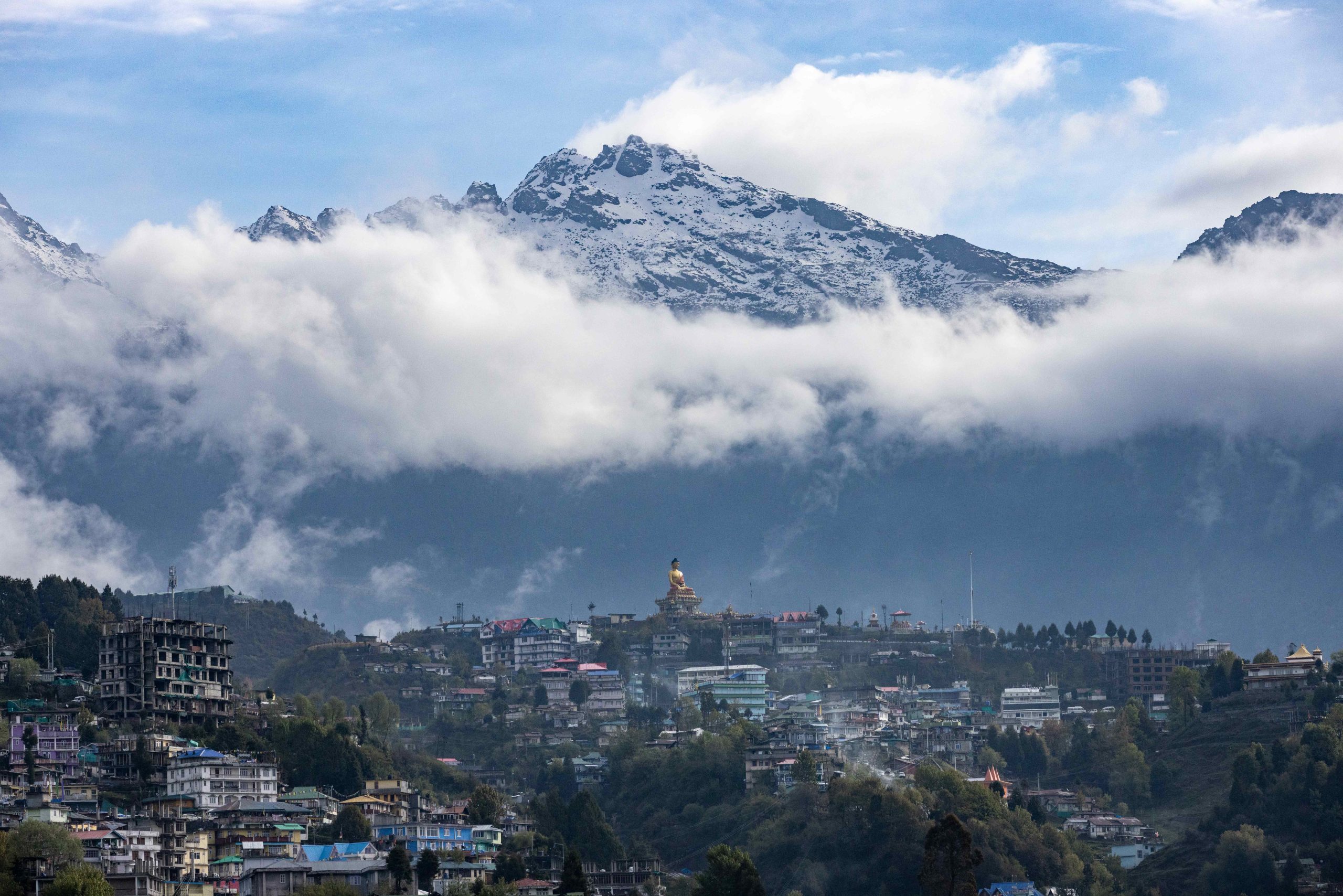
India and China draw a line in the snow
“People here, local people, just don't take it very seriously,” said Jambey Wangdi as he sipped on some fresh watermelon juice in a hotel in Tawang, a town in the state of Arunachal Pradesh that sits on India’s jagged eastern Himalayan border with China. He punctuated these words with a phlegmatic shrug. I had asked him how Arunachali people feel about being on the frontline of an intense, intractable and very current border dispute between two nuclear powers.
The Big Idea: Shifting Borders
Borders are liminal, notional spaces made more unstable by unparalleled migration, geopolitical ambition and the use of technology to transcend and, conversely, reinforce borders. Perhaps the most urgent contemporary question is how we now imagine and conceptualize boundaries. And, as a result, how we think about community.
In this special issue are stories of postcolonial maps, of dissidents tracked in places of refuge, of migrants whose bodies become the borderline, and of frontier management outsourced by rich countries to much poorer ones.
On June 21, Indian Prime Minister Narendra Modi began a four-day “state visit” to the United States — an event that is slightly more ceremonial than an “official” visit and an honor typically reserved for close allies. High on the agenda will be both countries’ strategic need to counter China’s economic and military might and its regional assertiveness. India is being talked up by the Biden administration as the “cornerstone of a free, open Indo-Pacific.” But as the U.S. and India grow closer, the latter’s diplomatic relations with China have nosedived. “This is the worst time I’ve seen in my living memory in I-C relations,” tweeted Nirupama Menon Rao, the former Indian ambassador to both China and the United States. “And I’m not exaggerating. It’s serious.”
On the eve of his visit to the U.S., Modi told the Wall Street Journal in a rare interview, that for “normal bilateral ties with China, peace and tranquility in the border areas is essential.” Last month, I traveled to Tawang, which sits 10,000 feet above sea level and about 20 miles from Bum La Pass, the border post between India and Chinese-occupied Tibet. China has long claimed Tawang, a center of Tibetan Buddhism, as rightfully Chinese. I met Wangdi at a ritzy resort on the city’s outskirts. A high-ranking functionary in the Arunachal Pradesh government, he was keen to impress upon me the patriotism of people in the state. “Physically we may look a bit different, the shape of our eyes may be different,” he told me. “But emotionally, mentally, we really consider ourselves to be true Indians.”
According to Wangdi, the Indian government’s focus on improving infrastructure in the northeast of the country means that Arunachal Pradesh and Tawang in particular are booming. As I drove up to Tawang from the plains on freshly paved roads, evidence was everywhere. Unfinished construction, scattered outcroppings of concrete mushrooms, marred the mountainscape.


